

If you have spent any time shopping for fishing rods, you have probably noticed that rods come labeled as “ultralight” or “light” and wondered what the actual difference is. On the surface they look almost identical, but choosing the wrong one for your fishing style can cost you fish, frustration, and money.
This article focuses on one specific question: the difference between these two rod types. If you want the complete picture including top rod picks, gear recommendations, and full technique breakdowns head over to our main guide: Best Ultralight Fishing Rods: Complete Guide to Gear, Techniques & Top Picks
In this guide, we break down exactly what separates an ultralight rod from a light tackle rod — covering power ratings, line weight, lure weight, ideal use cases, and which rod is the right choice for your fishing style.
1. Understanding Rod Power Ratings
Before comparing the two, it helps to understand what “power” actually means. Rod power refers to the amount of force required to bend the rod — its stiffness or backbone. Manufacturers use a standard scale:
Ultralight (UL) → Light (L) → Medium Light (ML) → Medium (M) → Medium Heavy (MH) → Heavy (H)
Ultralight sits at the very bottom — the most flexible and sensitive of all. Every step up the scale means more stiffness, heavier line, and larger fish capability.
Rod power is different from rod action. Power = how much force bends it. Action = where on the blank the bend happens — tip, mid, or full.
2. What Is an Ultralight Rod?
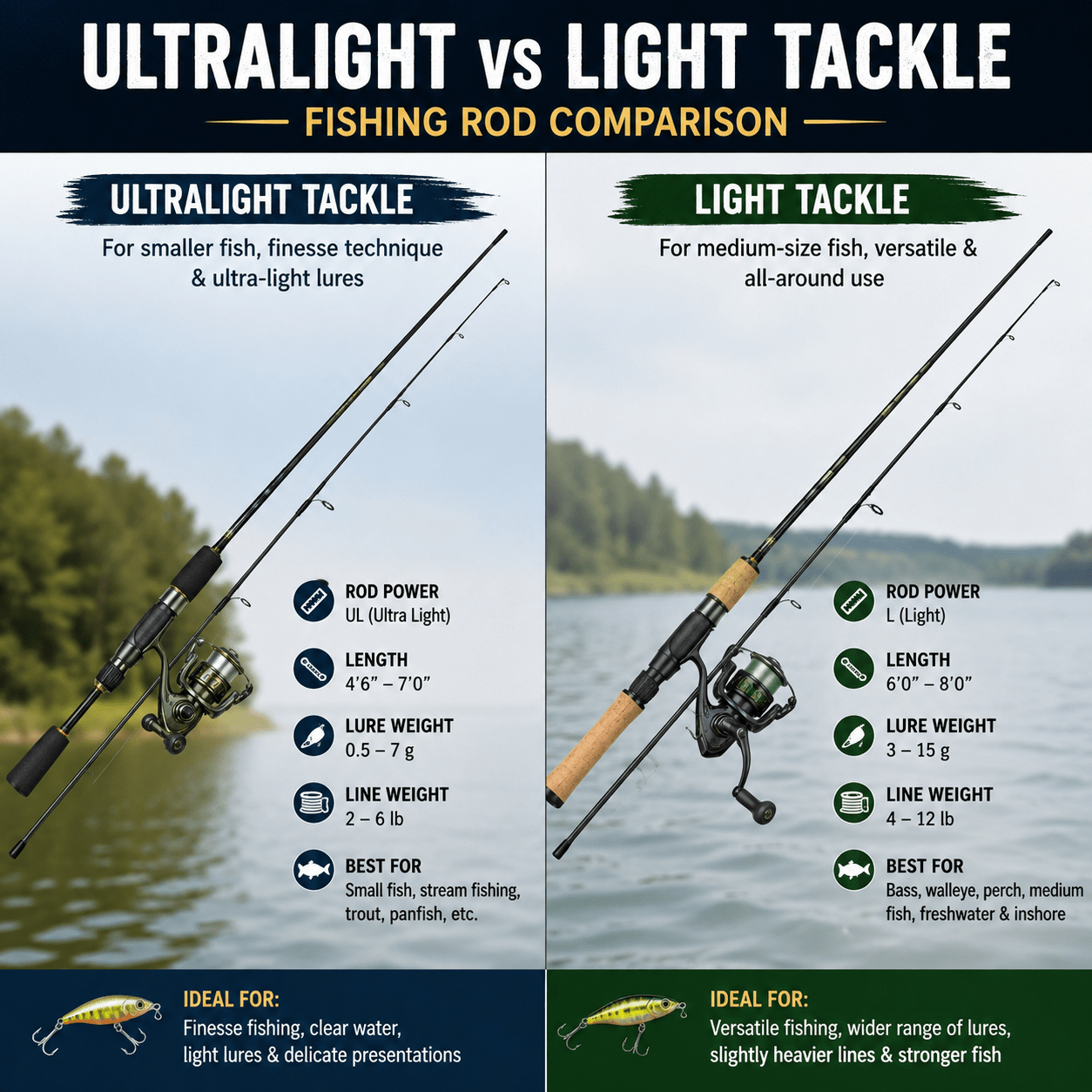
An ultralight (UL) rod is built for maximum sensitivity and the lightest possible presentations. It is designed for small fish, tiny lures, and situations where feeling every subtle bite matters more than raw power.
Ultralight Rod Specifications:
- Line Weight: 2–6 lb monofilament / 2–8 lb braid
- Lure Weight: 1/64 oz to 1/4 oz
- Action: Fast or extra-fast
- Length: 5’0″ to 7’0″
- Material: Graphite or high-modulus carbon fiber for maximum sensitivity
What Makes It Special?
- The defining quality of an ultralight rod is its sensitivity. Because the blank is so thin and flexible, you feel every tap, nudge, and head shake with extraordinary clarity. This makes it ideal for fishing tiny jigs, micro spinners, and small live baits where a heavier rod would mask the bite entirely.
- Of course, sensitivity alone does not tell the full story. The species you are targeting, the water you are fishing, and the presentations you use all determine whether ultralight is the right choice — something we cover in depth in What Is an Ultralight Fishing Rod Good For
Best Use Cases for Ultralight Rods
- Trout in streams and rivers
- Panfish — bluegill, crappie, perch
- Small bass with finesse techniques
- Micro jigging and drop shot presentations
- Ice fishing
Our Top Ultralight Rod Recommendations:
3. What Is a Light Tackle Rod?
A light (L) rod sits one step above ultralight on the power scale. It has slightly more backbone and handles a broader range of fishing situations — making it the more versatile of the two.
Light Rod Specifications
- Line Weight: 4–10 lb monofilament / 6–14 lb braid
- Lure Weight: 1/16 oz to 3/8 oz
- Action: Fast or moderate-fast
- Length: 6’0″ to 7’6″
- Material: Graphite, fiberglass, or composite
What Makes It Different?
Compared to ultralight, a light rod is slightly stiffer. You still feel bites well, but the extra backbone gives you better control when casting heavier lures or fighting a fish that runs hard. This is why light rods are popular with anglers who want a single rod for mixed-species fishing.
The tradeoff is sensitivity — a light rod will not transmit the same level of feel as an ultralight, which matters when you are fishing light presentations in clear, pressured water.
Top Light Rod Recommendations:
4. Ultralight vs Light — The Real Differences
Here is where things get practical. These are the three differences that actually change how you fish:
Difference 1: Lure Weight Range
Ultralight rods are built for the smallest lures available — 1/64 oz micro jigs, size 12–14 hooks, tiny inline spinners. A light rod can handle those too, but it really shines with slightly heavier presentations like 1/8 oz jigs, small crankbaits, and ned rigs.
If you are fishing presentations below 1/8 oz, ultralight is almost always the better tool. Above that threshold, a light rod gives you better loading on the cast and more control during the retrieve.
Difference 2: Line Strength
Ultralight rods are rated for 2–6 lb mono. Going heavier reduces the rod’s ability to load properly, dulls sensitivity, and puts unnecessary stress on the guides. Light rods handle up to 10 lb mono without issue which also means they can absorb a harder initial run from a larger fish without the panic that comes with ultralight gear.
Difference 3: Target Species and Fish Size
Ultralight rods are at their best with fish under 2–3 lbs. Trout, bluegill, crappie — species where the fight itself is the reward. If trout is your primary target, the light vs ultralight trout comparison breaks down which rod gives you a real advantage depending on the water type and trout size.
Light rods are better suited to mixed-species fishing where you might hook a 1 lb crappie one cast and a 4 lb bass the next. The extra power gives you confidence to handle whatever grabs the lure.
That said, ultralight rods are more capable than most anglers give them credit for. With the right drag setting and technique, landing larger fish on ultralight gear is absolutely possible — we cover exactly how in Can I Use an Ultra Light Rod for Big Fish
5. Which One Should You Choose?
Simple rule: If your target species are under 2 lbs and you are using lures under 1/8 oz — go ultralight. If you fish a wider mix of species and lure weights go light.
Go Ultralight If:
- You fish small streams, creeks, or ponds
- Your primary targets are trout, panfish, or small bass
- You use micro jigs, small spinners, or tiny live baits
Sensitivity and feel are your highest priority
Go Light If:
- You fish larger lakes, rivers, or inshore saltwater
- Your catch varies between small panfish and medium bass or walleye
- You want one rod that covers a wider range of presentations
- You occasionally target fish over 3–4 lbs
Can You Use One Rod for Both?
Technically yes — but you always make a compromise. A light rod used for ultralight presentations will miss subtle bites. An ultralight used for larger fish risks overpowering the blank. If your budget allows it, having both is the ideal setup.
And if you are building a complete ultralight setup from scratch, the rod is only half the equation. Pairing it with the right reel makes a significant difference in balance, casting distance, and line management — see our guide on How Do You Choose the Right Ultralight Rod and Reel Combination for a complete breakdown.
6. Common Mistakes to Avoid
- Using line that is too heavy on an ultralight — dulls sensitivity and can snap the tip under load
- Pairing an ultralight blank with a large reel — throws off balance and causes arm fatigue
- Assuming a light rod will do everything an ultralight does — you will miss bites on finesse presentations
- Ignoring rod action — two rods with the same power rating can fish very differently if one is fast and the other moderate
One more thing anglers overlook — the lure and bait selection matters just as much as the rod itself. Even the best ultralight rod will underperform if you are throwing the wrong presentation. Check out Best Baits and Lures for Ultralight Fishing Success for a full breakdown of what works best on ultralight gear.
Final Thoughts
The difference between an ultralight and a light tackle rod comes down to three things: flexibility, line rating, and the size of fish it is built to handle comfortably.
Ultralight rods are specialists — extraordinary at what they do, but purpose-built for small fish and light presentations. Light rods are generalists — a step up in power that gives you versatility without sacrificing too much sensitivity.
Understanding this distinction means you stop guessing at the tackle shop and start making intentional choices. Match the rod to the species, the water, and the presentation — and every session becomes sharper and more productive.
Ready to take the next step? Our complete guide Best Ultralight Fishing Rods: Complete Guide to Gear, Techniques & Top Picks covers everything from top rod picks to full setup recommendations.