

So what is an ultralight fishing rod good for? It is a fair question — especially when you are standing in a tackle shop staring at a wall of rods that all look the same. Ultralight rods are the thinnest, most sensitive, and most flexible rods in the fishing world. But that flexibility is not a weakness. It is the entire point.
An ultralight fishing rod is good for exactly the situations where every other rod type falls short: fishing tiny lures in clear water, targeting small fish species that demand a delicate presentation, and detecting bites so subtle that a heavier rod would miss them entirely.
This article covers every situation where an ultralight rod genuinely excels. If you are also looking for specific rod recommendations to match these situations, our main guide Best Ultralight Fishing Rods: Complete Guide to Gear, Techniques & Top Picks has you covered.
1. What Exactly Is an Ultralight Fishing Rod?
Before diving into what an ultralight fishing rod is good for, it helps to understand what makes it different from every other rod on the rack.
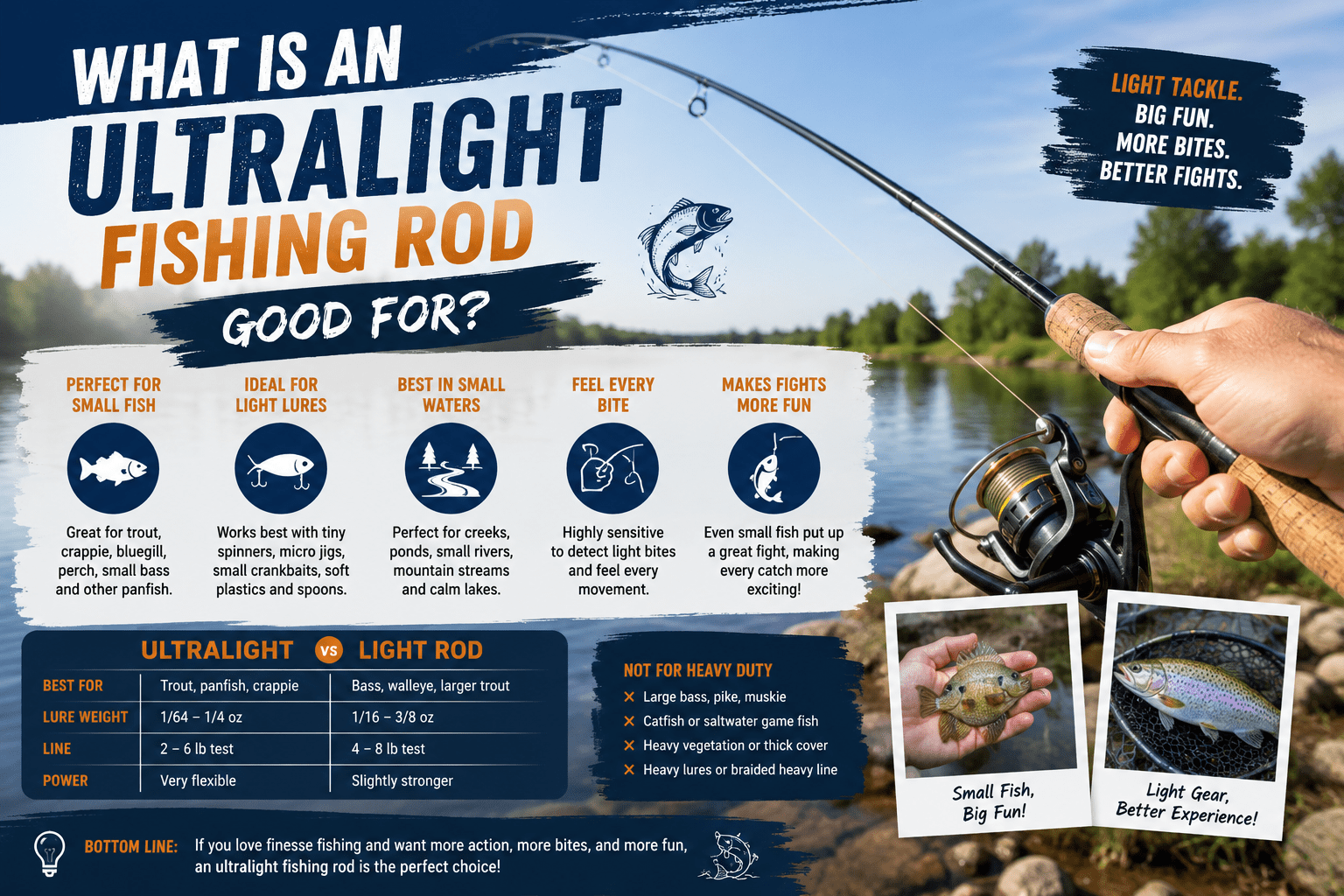
An ultralight rod (UL) is rated for the lightest line and lure weights in fishing — typically 2 to 6 lb monofilament and lures between 1/64 oz and 1/4 oz. The blank is thin, flexible, and built from high-sensitivity materials like graphite or high-modulus carbon fiber. When you hold one, it almost feels too light — like it might snap under pressure.
It will not. That flexibility is engineered. It is what allows the rod to load properly with tiny lures, transmit the faintest bites to your hand, and cushion the fight of a fish so that even a 10-inch trout feels like a battle worth having.
What is an ultralight fishing rod good for in one sentence?
It is good for any fishing situation that demands precision, sensitivity, and finesse over raw power.
2. What Is an Ultralight Fishing Rod Good For? 8 Real Situations
1. Trout Fishing in Streams and Rivers
This is where ultralight rods were born. Stream trout whether brown, rainbow, or brook — are line-shy, spooky, and selective. They live in clear water and can see heavy line and unnatural presentations from metres away.
An ultralight rod lets you fish 2–4 lb fluorocarbon with tiny size 10–14 hooks, micro spinners, and small inline lures. The thin blank loads beautifully on short casts, and the sensitivity lets you feel the tick of a trout mouthing a bait before it spits it.
If trout is your primary focus, the rod choice goes deeper than just ultralight vs light. Water type, trout size, and presentation style all play a role which is exactly what we break down in Is a Light or Ultralight Rod Better for Trout. .
Our Top Ultralight Rod Recommendations:
2. Panfish Bluegill, Crappie, and Perch
Panfish are the bread and butter of ultralight fishing. Bluegill, crappie, yellow perch — these species hit small jigs and live baits hard, fight well for their size, and are incredibly fun on ultralight gear.
The real advantage here is lure size. Panfish respond best to tiny jigs — 1/32 oz and 1/16 oz that a medium or even light rod simply cannot cast accurately. An ultralight loads the blank with even these tiny weights and puts them exactly where you want them.
On a 5’6″ or 6′ ultralight rod, a 300g bluegill feels like a proper fight. That is the magic of matching the gear to the species.
3. Small Bass Fishing with Finesse Techniques
Bass fishing is dominated by heavy gear — but not all bass fishing. When the bite gets tough, water clears up, or you are targeting smaller impoundments and creeks, finesse techniques on ultralight tackle are often the most productive approach.
Drop shotting with 3-inch plastics, shaky head rigs, and micro ned rigs all work better on an ultralight rod. The sensitivity lets you feel bottom composition, detect pressure bites, and set the hook on fish that barely move the lure.
Finesse bass fishing on ultralight gear is not a compromise — it is a strategy. In pressured water, downsizing your presentation on an ultralight rod will often out-produce heavier setups by a wide margin.
4. Micro Jigging
Micro jigging is one of the fastest-growing techniques in light tackle fishing and it is built around ultralight gear. The technique involves working small metal jigs, typically 3–15 grams, with short, sharp rod movements to imitate injured baitfish.
What is an ultralight fishing rod good for in a jigging context? It gives you the sensitivity to feel every pause, flutter, and tap that a micro jig produces on the way down — and the fast action tip to impart the right movement. For a full breakdown of jigging setups and techniques on ultralight gear, see What Is the Difference Between Ultralight and Light Tackle Fishing Rod for how rod choice affects jigging performance.
5. Ice Fishing
Ice fishing demands the ultimate in sensitivity you are often fishing in 10–15 feet of water with tiny jigs under a bobber, waiting for a bite that might be nothing more than a slight upward movement of the line. An ultralight rod is the natural tool for this environment.
Shorter ultralight blanks 24 to 36 inches are specifically designed for ice fishing, but standard ultralight spinning rods work well through large holes too. The flexibility of the blank absorbs the sudden surges of fish like crappie and perch without tearing the hook free.
6. Creek and Small Water Fishing
Small creeks, drainage channels, farm dams, and tight river sections all benefit from ultralight gear. These environments demand short, accurate casts often underhand or sidearm with small lures that do not spook fish in shallow, clear water.
A 5’0″ to 6’0″ ultralight rod is ideal for these situations. It is short enough to cast under overhanging branches, light enough to fish all day without fatigue, and sensitive enough to detect bites in current where fish hold for a fraction of a second.
7. Teaching Beginners and Kids to Fish
What is an ultralight fishing rod good for beyond catching fish? Teaching people to fish. Ultralight rods are forgiving, lightweight, and make even small fish exciting enough to keep a beginner engaged.
The light weight means a child can hold and cast the rod comfortably for hours. The sensitivity means they feel every bite. And the fact that even a small perch puts up a real fight on ultralight gear means every fish is an event not a disappointment.
8. Any Situation That Demands Finesse Over Power
Clear water. Pressured fish. Post-cold-front conditions. Heavily fished public water. These are the scenarios where ultralight gear separates confident anglers from frustrated ones.
When fish are educated and cautious, dropping down to an ultralight rod, lighter line, and smaller lures is often the difference between a blank session and a productive one. The ultralight rod is not just a tool for small fish it is a tool for difficult conditions.
3. What Species Can You Target on an Ultralight Rod?
The honest answer: more than most anglers realize. Here is a practical breakdown:
Ideal Species Built for Ultralight
- Rainbow, brown, and brook trout
- Bluegill and sunfish
- Crappie
- Yellow perch
- Small bass (under 1.5 kg)
- Whiting and small flathead (inshore)
- Roach, rudd, and dace (European freshwater)
Possible But Requires Skill
Some anglers push ultralight gear well beyond its “intended” species list — targeting larger bass, walleye, snapper, and even salmon on ultralight tackle. It is absolutely possible with the right drag settings and technique. We cover exactly how to do this safely in Can I Use an Ultra Light Rod for Big Fish.
- Largemouth and smallmouth bass over 2 kg
- Walleye
- Small to medium snapper inshore
- Salmon in smaller rivers
4. What Lures and Baits Work Best on an Ultralight Rod?
An ultralight rod is only as good as the presentation you pair with it. Here are the lures and baits that work best:
Lures
• Micro jigs — 1/64 oz to 1/8 oz, in grub, paddle tail, or tube profiles
• Inline spinners — size 0 to size 2 (Mepps Aglia, Panther Martin)
• Micro crankbaits — 3–5 cm floating or suspending
• Small soft plastics on a 1/32 oz or 1/16 oz jig head
• Ned rig with a small EWG hook and floating plastics
• Beetle spins and small spinnerbaits
Natural Baits
• Small garden worms on a size 10–12 hook
• Crickets and grasshoppers
• Small minnows under a light float
• Maggots and grubs for panfish
• Small pieces of prawn for inshore species
Choosing the right bait goes deeper than just lure size. Colour, action, and retrieve speed all change how fish respond. For a complete breakdown of what actually works on ultralight gear across different species and conditions, see Best Baits and Lures for Ultralight Fishing Success
5. What Are the Advantages of an Ultralight Fishing Rod?
- Maximum sensitivity — feel every bite, tap, and bottom change through the blank
- Longer fights — the flexible blank absorbs runs and head shakes, making every fish more exciting
- Accuracy with small lures — loads properly with 1/32 oz and 1/16 oz weights that heavier rods cannot cast
- All-day comfort — lighter rod weight reduces arm fatigue on long sessions
- Versatility in small water — shorter lengths navigate tight spaces and overhanging cover
- Better hooksets on light line — the rod flex prevents line breakage on the strike
6. What Are the Limitations of an Ultralight Rod?
No rod does everything. Here is where ultralight gear falls short:
- Not suitable for fish over 3–4 kg without advanced drag management
- Limited casting distance with lures over 1/4 oz
- Vulnerable to damage if used with line heavier than 8 lb
- Not ideal for heavy cover — thin blank lacks the backbone to pull fish from thick weed or timber
- Reduced leverage in fast current when fish use the flow against you
The solution to most ultralight limitations is not switching to a heavier rod — it is adjusting your drag, your line choice, and your fish-fighting technique. Knowing the rod’s limits is what separates experienced ultralight anglers from beginners.
7. Choosing the Right Ultralight Rod for Your Situation
Not all ultralight rods are equal. The right choice depends on where and how you fish:
For Stream Trout
Look for a 5’6″ to 6’6″ fast action ultralight in graphite. Sensitivity and tip speed matter more than backbone here.
For Panfish and Crappie
A 6’0″ to 7’0″ ultralight with a moderate-fast action gives you the casting range and forgiving tip needed for light jigs and live bait under a float.
For Micro Jigging
A shorter 5’0″ to 6’0″ fast action ultralight gives you the precise tip movement needed to work micro jigs effectively. Look for high-sensitivity graphite or carbon blanks.
Of course, the rod is only half the setup. Matching it to the right reel — in terms of size, gear ratio, and drag system — changes everything about how the outfit fishes. See How Do You Choose the Right Ultralight Rod and Reel Combination for a complete guide on building the perfect ultralight setup.
Final Thoughts
So what is an ultralight fishing rod good for? The short answer: any fishing situation that rewards precision, sensitivity, and finesse over brute force.
Ultralight rods are good for trout in clear streams, panfish in ponds, bass on finesse presentations, micro jigging in deeper water, ice fishing, teaching beginners, and making even the smallest fish feel like a genuine challenge. They are the most fun rod class in fishing and the most underestimated.
The anglers who reach for an ultralight rod are not compromising. They are choosing to fish smarter, feel more, and enjoy every fish regardless of size.
Ready to find the right ultralight rod for your specific situation? Our complete guide Best Ultralight Fishing Rods: Complete Guide to Gear, Techniques & Top Picks covers every rod type, price range, and fishing scenario with specific product recommendations.